کیا ذو الفقار علی بُھٹو نے ڈھاکا میں مقیم بنگالی خاتون حُسنہ شیخ سے شادی شیخ مجیب الرحمٰن کا مشرقی پاکستان میں سِیاسیِ مقابلہ کرنے کے لیے کی تھی؟
جیسے ہی سقوط ڈھاکا ہوا تو دھوکے باز ذوالفقار علی بُھٹو نے حُسنہ شیخ سے ہونے والے نکاح کی دستاویزات ضائع کردیں اور قرآن شریف بھی غائب کردیا جسے انہوں نے گواہ بنایا تھا۔

The famous former Prime Minister of Pakistan, Z. A. Bhutto, is largely known to have married twice. Both of his wives are well-known: the quiet and obedient Shirin Amir Begum, and the glitzy Nusrat Bhutto, who also became Pakistan’s First Lady. But there was another, a third hidden wife, Husna Sheikh. Zulfiqar Ali Bhutto never acknowledged her publicly, but she became a powerful figure in his regime.
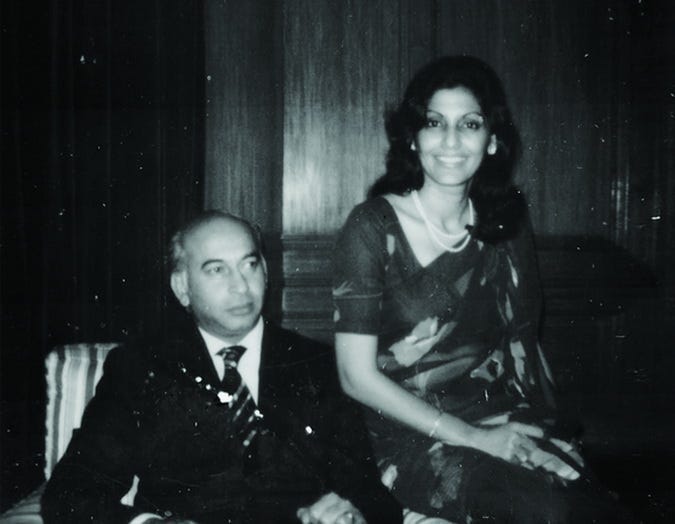
Zulfiqar Ali Bhutto with his Third Wife, Husna Sheikh (December 1971)
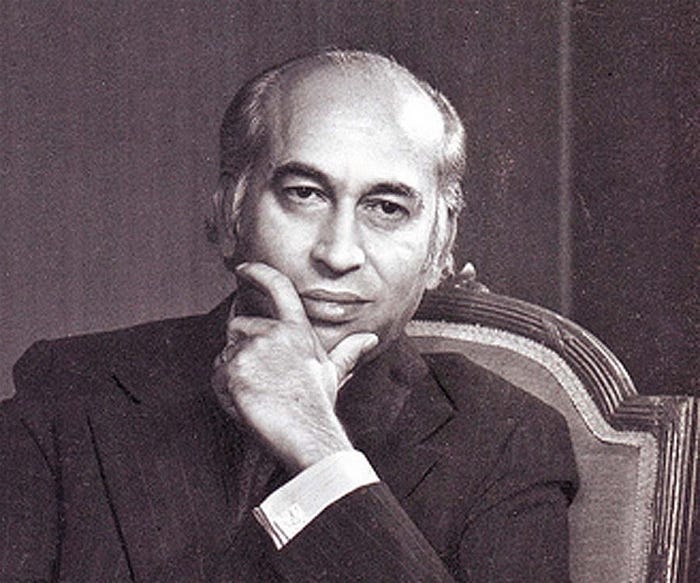
Zulfiqar Ali Bhutto
Zulfiqar Ali Bhutto was one of the most colourful politicians produced by Pakistan. Flamboyant, articulate, charming, highly educated, extremely intelligent and entirely unpredictable. My late father, who was close to him, once described Zulfiqar Ali Bhutto as ‘a disorientating combination of a sophisticated intellectual, a firebrand politician, an amoral pragmatist and an unabashed romantic.’ He said that ‘Zulfiqar Ali Bhutto was a Marx, Stalin, de Gaulle, and Don Juan all rolled into one.
Born into an influential family of landowners in Larkana and to a father who was a member of Jinnah’s All India Muslim League (AIML), Zulfiqar Ali Bhutto was married off to a cousin at a young age. But he hardly spent any time with his wife because he was soon off to the US and then the UK to bag degrees in political science and law.
Zulfiqar Ali Bhutto briefly returned to Pakistan in 1950, and, according to an interview that his first wife, Shirin Amir Begum, gave to a Zulfiqar Ali Bhutto-related website (Bhutto.org), Zulfiqar Ali Bhutto politely told her that he planned to marry another woman. That other woman was the sophisticated Kurdish-Iranian Lady, Nusrat Ispahani.
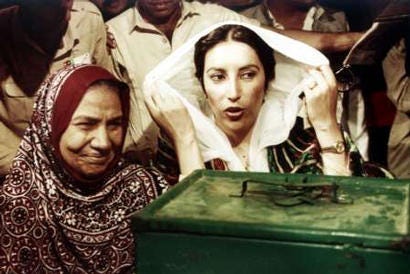
Zulfiqar Ali Bhutto’s First Wife, Shirin Amir Begum, with Benazir in 1988
Nusrat’s family had moved to Karachi from Mumbai after the creation of Pakistan in 1947. Zulfiqar Ali Bhutto and Nusrat tied the knot in 1951. The couple would go on to have four children, two boys and two girls. Zulfiqar Ali Bhutto never divorced his first wife, though she stayed in Larkana and was supported by Zulfiqar Ali Bhutto’s family.
In 1958, aged 32, Zulfiqar Ali Bhutto became one of the youngest members of President Iskandar Mirza’s cabinet. He was retained as a minister after Mirza and military chief General Muhammad Ayub Khan imposed the country’s first martial law. Zulfiqar Ali Bhutto’s youthful intelligence, charisma and work ethic impressed General Muhammad Ayub Khan, and he decided to keep Zulfiqar Ali Bhutto in his cabinet after he (Ayub) ousted Mirza just 17 days after the military coup.
Stanley Wolpert, in his authoritative biography of Zulfiqar Ali Bhutto, wrote that he (Bhutto) became ‘Ayub’s blue-eyed boy’. Ayub encouraged Zulfiqar Ali Bhutto’s assertive style of politics. Wolpert wrote that Ayub often used Zulfiqar Ali Bhutto to counter any pushback his policies received from the much older ministers in the cabinet.
Wolpert also added that by 1961, General Muhammad Ayub Khan had become much more than just a boss to General Muhammad Ayub Khan. He became his mentor and then a father figure. Zulfiqar Ali Bhutto was often heard addressing General Muhammad Ayub Khan endearingly as his ‘Daddy.’
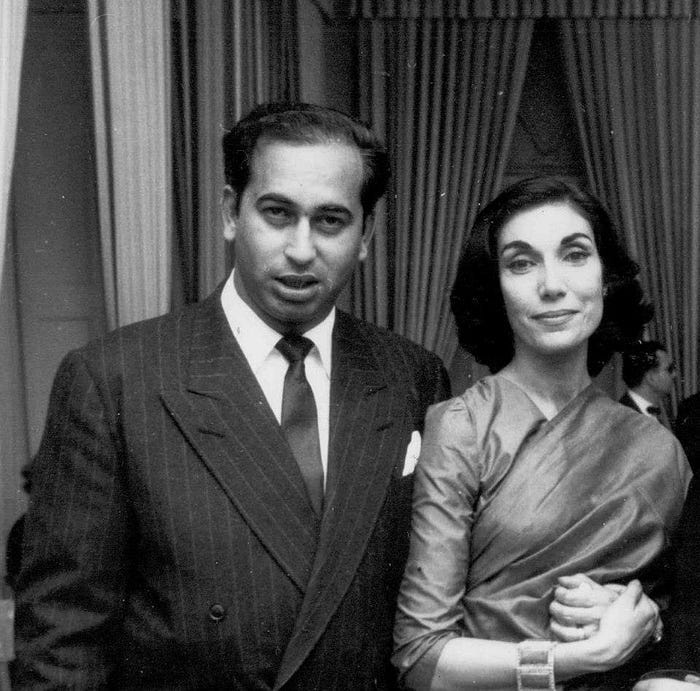
Zulfiqar Ali Bhutto with his Second Wife, Nusrat (1950s)
Almost everyone who came across General Muhammad Ayub Khan and wrote about him has described him as an admixture of an unabashed extrovert and an introvert. He was known for talking endlessly about everything under the sun — politics, history, cricket, music, poetry — and thriving in boisterous gatherings. Yet, even when he became President and then Prime Minister of Pakistan in the 1970s, he would regularly retreat alone into his personal library with his glass of whisky and his cigar and read there for hours, not meeting anyone.
In 1961, the then 34-year-old minister and General Muhammad Ayub Khan’s ‘blue-eyed-boy’, bumped into a young woman at a party in Dhaka (in former East Pakistan). The woman’s name was Husna Sheikh. Husna, at the time, was in her late twenties and married to a successful Bengali lawyer, Abdul Ahad. The couple had two young daughters. Fluent in Urdu, English and Bengali, Husna had a mixed Bengali-Pashtun ancestry. Zulfiqar Ali Bhutto was immediately smitten by Husna’s good looks, wit and sharp mind.
The December 31, 1977, edition of India Today (in a belated story on Husna’s relations with Zulfiqar Ali Bhutto) reported that Husna was not getting along with her lawyer husband at the time. Even though Zulfiqar Ali Bhutto pursued her with all his lady-killing charms, Husna remained out of his reach.
This frustrated Zulfiqar Ali Bhutto to no end, until in 1965, when she finally decided to leave her husband and move to Karachi with her two daughters. She lodged herself in an apartment at Karachi’s then very ‘posh’ locality, the Bath Island, which is just a 10-minute-drive from Zulfiqar Ali Bhutto’s home in the city’s Clifton Area (70 Clifton).
Maliha Lone, in her 2016 article on the affair, wrote (in The Friday Times) that Ghulam Mustafa Khar facilitated Zulfiqar Ali Bhutto’s fake love affair with Husna once she settled in Karachi. Only Ghulam Mustafa Khar, then a close confidant of Zulfiqar Ali Bhutto, knew about the planned love affair. He would quietly drive Zulfiqar Ali Bhutto to Husna’s flat on Bath Island. However, the year the affair finally took off (in 1965) was also the year when Zulfiqar Ali Bhutto eventually had a falling out with his mentor, General Muhammad Ayub Khan.
In 1966, Zulfiqar Ali Bhutto was quietly eased out by Ayub. In 1967, Zulfiqar Ali Bhutto rebounded to form his own party, the populist and left-leaning Pakistan People’s Party (PPP). Husna was a confident, well-read and headstrong woman.
Maliha Lone quotes Tehmina Durrani as writing (in her book My Feudal Lord) that by the late 1960s, the affair had become highly charged and stormy, and Husna would often slam the door on Zulfiqar Ali Bhutto’s face!
In 1967, Husna managed to win a lucrative contract to decorate the palace of Sheikhia Fatima of Abu Dhabi and was able to buy two properties in Karachi. This was her way of asserting her independence. She also told Zulfiqar Ali Bhutto that she would not meet him unless he married her.
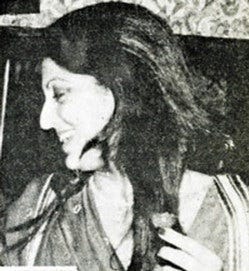
Zulfiqar Ali Bhutto’s Third Wife, Husna Sheikh, in 1968
In 1968, when Zulfiqar Ali Bhutto and his PPP were at the forefront of a tumultuous student and labour movement against General Ayub Khan’s regime, Husna managed to convince him to marry her. However, in 1969, just when Zulfiqar Ali Bhutto had decided to tie the knot with Husna, he was arrested and thrown in jail for ‘instigating violence against the state.’ Zulfiqar Ali Bhutto requested Husna to lie low, promising to marry her once General Ayub Khan was toppled. She obliged.
Maliha Lone wrote that Zulfiqar Ali Bhutto met Husna after General Ayub Khan resigned in March 1969. She told him, ‘How can you do this to me? You are my destiny.’ Lone adds that hearing this, Zulfiqar Ali Bhutto broke down and ‘cried like a child.’ Wolpert wrote that the year Zulfiqar Ali Bhutto’s PPP won the most seats in the western wing of the country (during the 1970 election), he was once again being secretly driven by Ghulam Mustafa Khar to Husna’s Bath Island apartment in Karachi.
However, one day, Zulfiqar Ali Bhutto and Husna had a huge fight (because he was again backtracking on her promise of marriage). In desperation, Zulfiqar Ali Bhutto again promised to marry her and wrote his promise on the inside cover of a copy of the Holy Quran. But, Wolpert writes, soon Zulfiqar Ali Bhutto got cold feet, and when Husna was elsewhere in the house, Zulfiqar Ali Bhutto hid the copy of the Holy Book in his pocket and beat a hasty retreat.
The problem was that it wasn’t time for him to be picked up by Ghulam Mustafa Khar. So Zulfiqar Ali Bhutto had to walk all the way back to his 70 Clifton home, which is about a 30-minute walk from Bath Island.
Since by then he had become a well-known figure whose party had swept an election (In Punjab and Sindh), Zulfiqar Ali Bhutto tried to take as many quiet streets and routes as he could during his walk back. Zulfiqar Ali Bhutto often gifted Husna various books on politics and history, which she used to devour and then discuss with him during their ‘Clandestine Dates.’
One day in mid-1971, he gifted her a beautiful copy of the Holy Quran (not the one he had earlier nicked). On the wrapping paper, he wrote, ‘To my wife, Husna.’ Just days after he became President of Pakistan (20 December 1971), he quietly married her. The nikkah was performed by the progressive Islamic scholar and Pakistan People’s Party member, Maulana Kausar Niazi, and witnessed by Ghulam Mustafa Khar.
Wolpert wrote that even though he remained married to Husna, he got the Quran removed from Husna’s home when he became prime minister in 1973. It was never found, not even by the police when — after Zulfiqar Ali Bhutto was toppled in a reactionary military coup in 1977 — the cops were sent to raid Husna’s apartment.
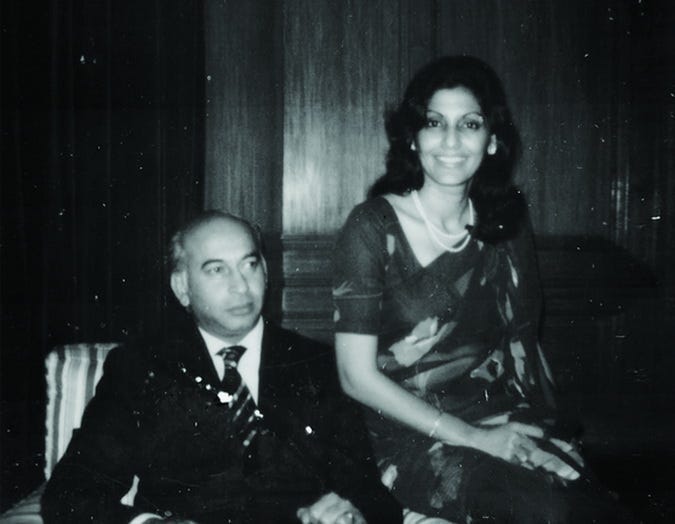
ZAB & Husna: Newly Married Couple (December 1971)
Zulfiqar Ali Bhutto’s second wife, the elegant Nusrat, too, was a headstrong woman. The mother of Zulfiqar Ali Bhutto’s four children, someone told her about her husband’s secret marriage to Husna. No one really knows exactly how she came to know about it, but there is every likelihood that she was somewhat aware of her husband’s affair with an outspoken Bengali Woman.
Maliha Lone writes that Nusrat Bhutto tried to end her own life by swallowing over a dozen sleeping pills. She survived and was shifted to a hospital in Rawalpindi. The distraught president begged her for forgiveness and told her that he could never abandon the mother of his children. Nusrat Bhutto recovered and became the official first lady of Pakistan.
Even though till Nusrat Bhutto’s suicide attempt, Husna had wanted Zulfiqar Ali Bhutto to acknowledge their marriage publicly, she finally settled for being Zulfiqar Ali Bhutto’s ‘hidden wife.’ But by all accounts, she was a powerful influence. In 1990, she told the editor of The Friday Times, Jugnu Mohsin, that Zulfiqar Ali Bhutto continued to visit her:
“Her home was frequently visited by ministers and powerful men seeking an audience with Zulfiqar Ali Bhutto or to deliver their messages to the very busy prime minister. Jugnu Mohsin wrote that she ran a ‘kitchen cabinet’ from her apartment, influencing many of the Zulfiqar Ali Bhutto regime’s economic and social policies.”
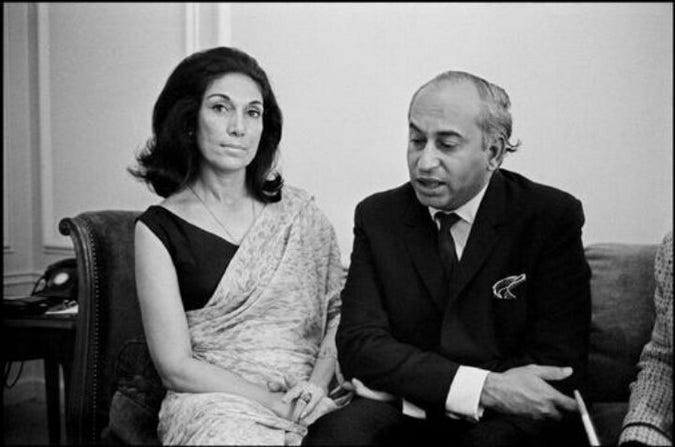
PM Zulfiqar Ali Bhutto and the First Lady Nusrat Bhutto
Husna Sheikh told Mohsin, one day, when she asked Zulfiqar Ali Bhutto why he was always in such a hurry, he told her that he knew ‘they’ would eventually kill him. She didn’t explain exactly who ‘they’ were. He might have been hinting at the military or the right-wing opposition groups who had grown stronger from the mid-1970s onward.
Husna Sheikh also told Jugnu Mohsin that when the results of the 1977 Election began to pour in, and the PPP was enjoying landslide victories even in constituencies in which the party was not strong, Zulfiqar Ali Bhutto complained, ‘Will someone tell my CMs not to ruin my 20 years of hard work!’
The opposition parties cried foul and began a violent protest movement, which became the basis of the July 1977 Martial Law and subsequent fall of the Zulfiqar Ali Bhutto regime. Observers have maintained that the PPP would have easily won another 5-year term, but various senior PPP ministers indulged in unabashed rigging in some ‘sensitive constituencies’ in the Punjab. Husna was in London when Zulfiqar Ali Bhutto’s government fell.
Husna Sheikh told Jugnu Mohsin that Zulfiqar Ali Bhutto’s eldest daughter (and future prime minister), Benazir, deeply resented her, but Zulfiqar Ali Bhutto’s son, Murtaza, was kind to her and kept her informed about his father’s fate. When Zulfiqar Ali Bhutto was being tried in a murder case in an entirely sham manner, Husna hired the services of a famous UK Lawyer, John Mathews. But General Zia’s Dictatorship refused to permit him to contest the case in a Pakistani Court.
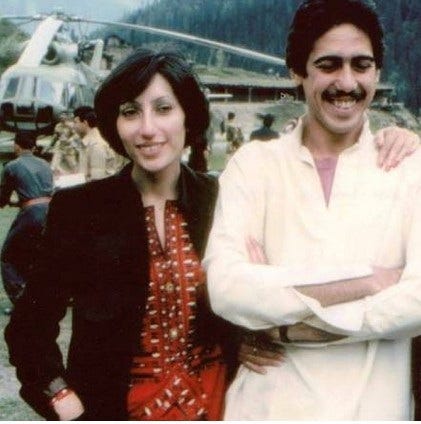
“Benazir and Murtaza had contrasting views about Husna. BB resented her, whereas Murtaza was more empathetic towards her.”
It was Murtaza Bhutto who informed Husna about Zulfiqar Ali Bhutto’s execution in April 1979. Husna fell into depression and contemplated committing suicide. By then, she had given birth to her only child (Shahmeen), the daughter of Zulfiqar Ali Bhutto. Now, she had no choice but to pull herself out of her depression for her daughter.
Husna Sheikh continued to live in London. Zulfiqar Ali Bhutto was hanged in 1979. Shirin Amir Begun died in 2003. Nusrat Bhutto passed away in 2011. She is still alive and in her eighties. She lives in London.
رہے جب تک اِقتِدار میں ذوالفقارعلی بُھٹو تو شہد خُوب کھاتے رہے
آیا جب زوال محسِن پر تو پِھر اُسے گلی گلی کُتا کہلواتے رہے
This story was originally published at Naya Daur on November 11, 2017, by Nadeem F. Paracha, a senior journalist of Pakistan.